
Business Social Media Calendars: Planning and Best Practices
Effective business social media calendars streamline content planning and improve engagement by organizing posts and tracking key dates efficiently.


A business social media calendar is a practical system for deciding what your company will publish, where it will appear, when it will go live, and who is responsible for it. By organizing campaigns, recurring content, production deadlines, approvals, and performance reviews in one place, businesses can maintain a consistent presence while creating more relevant posts. Effective social media planning for business is not about filling every available time slot; it is about connecting each post to a clear audience need and business objective.
Why Every Business Needs a Social Media Calendar | Set Goals Before Choosing Topics and Posting Times | Build the Right Structure for Your Business Content Calendar | Develop Content Pillars and a Balanced Publishing Mix | Plan an Efficient Workflow from Idea to Publication | Choose Posting Frequency and Timing with Evidence | Create Platform-Specific Content Without Duplicating Work | Measure Performance and Improve the Calendar | Common Calendar Mistakes to Avoid | Frequently Asked Questions | Turn Your Calendar into a Practical Growth System
Why Every Business Needs a Social Media Calendar
Without a calendar, social media management tends to become reactive. Teams rush to create posts, repeat topics unintentionally, miss important dates, and publish content simply because a channel has been quiet. A structured business content calendar replaces that uncertainty with a visible plan. It gives marketers enough time to develop stronger ideas, collect assets, secure approvals, and adapt content for each platform.
Consistency is one of the greatest advantages. Audiences are more likely to recognize and remember a brand when its content appears regularly and communicates a coherent point of view. Consistency does not require posting every day. It means establishing a sustainable rhythm that matches the team’s resources and the audience’s expectations.
A calendar also improves coordination across departments. Marketing may need product information from sales, expert commentary from leadership, images from design, or customer insights from support. When upcoming posts and deadlines are visible in advance, contributors can prepare without last-minute requests disrupting their work.
Planning also creates room for flexibility. This may sound contradictory, but a well-organized calendar makes it easier to respond to trends, news, or customer conversations. When the core schedule is already under control, the team can move or replace a planned post without losing track of the wider campaign.
Finally, a calendar connects publishing activity to results. When every post is associated with an objective, campaign, audience segment, and content theme, marketers can identify patterns in performance. The calendar then becomes more than a schedule: it becomes a record of what the business has tested and learned.

Set Goals Before Choosing Topics and Posting Times
A useful social media calendar begins with business goals, not content formats. Before deciding to publish a carousel, video, poll, or promotional post, define the result the business wants social media to support. Common goals include increasing brand awareness, generating qualified leads, building a community, improving customer retention, recruiting employees, or driving sales.
Translate broad goals into measurable social media objectives. For example, “increase awareness” can become “raise average monthly reach among small-business owners by 20% over the next quarter.” “Generate leads” might become “drive 150 qualified visits per month to the product demo page.” Specific objectives make it easier to select topics, calls to action, platforms, and metrics.
Next, clarify the audience. A company may serve several customer groups, but not every post should try to address all of them. Add an audience field to the calendar and identify the primary segment for each item. A software company, for instance, might alternate between educational content for end users, strategic insights for decision-makers, and technical guidance for implementation teams.
Choose metrics that correspond to the objective. Reach and video views can help assess awareness, while saves and shares often indicate practical relevance. Comments and direct messages may reveal community engagement. Clicks, form submissions, trial registrations, and attributed revenue are more appropriate for conversion-focused content. Avoid treating engagement rate as the universal measure of success; a customer-support post and a lead-generation post perform different jobs.
Each scheduled item should therefore answer four questions: Who is this for? What value does it provide? What action should the audience take? Which business goal does it support? If a post cannot answer these questions, it may be unnecessary or insufficiently developed.
Build the Right Structure for Your Business Content Calendar
The best calendar is detailed enough to prevent confusion but simple enough that the team will actually maintain it. A small business may work effectively with a spreadsheet, while a larger team may prefer a project-management platform or dedicated scheduling tool. The software matters less than having a shared, consistent structure.
At minimum, include the publication date and time, platform, post format, topic, draft copy, asset link, campaign, owner, approval status, and call to action. Add a destination URL and tracking parameters when a post sends users to a website. A notes field is useful for platform-specific requirements, tagging instructions, legal disclosures, or accessibility details.
Use workflow statuses such as “idea,” “briefed,” “in production,” “in review,” “approved,” “scheduled,” and “published.” These stages allow anyone to understand the state of an item without asking for an update. Assign one accountable owner to each post, even when several people contribute. Shared responsibility without clear ownership often leads to missed deadlines.
Include separate dates for drafting, asset delivery, review, approval, and publication. A publication date alone hides the production work required beforehand. Reverse-planning from the go-live date is especially important for video shoots, customer stories, influencer collaborations, contests, and regulated content.
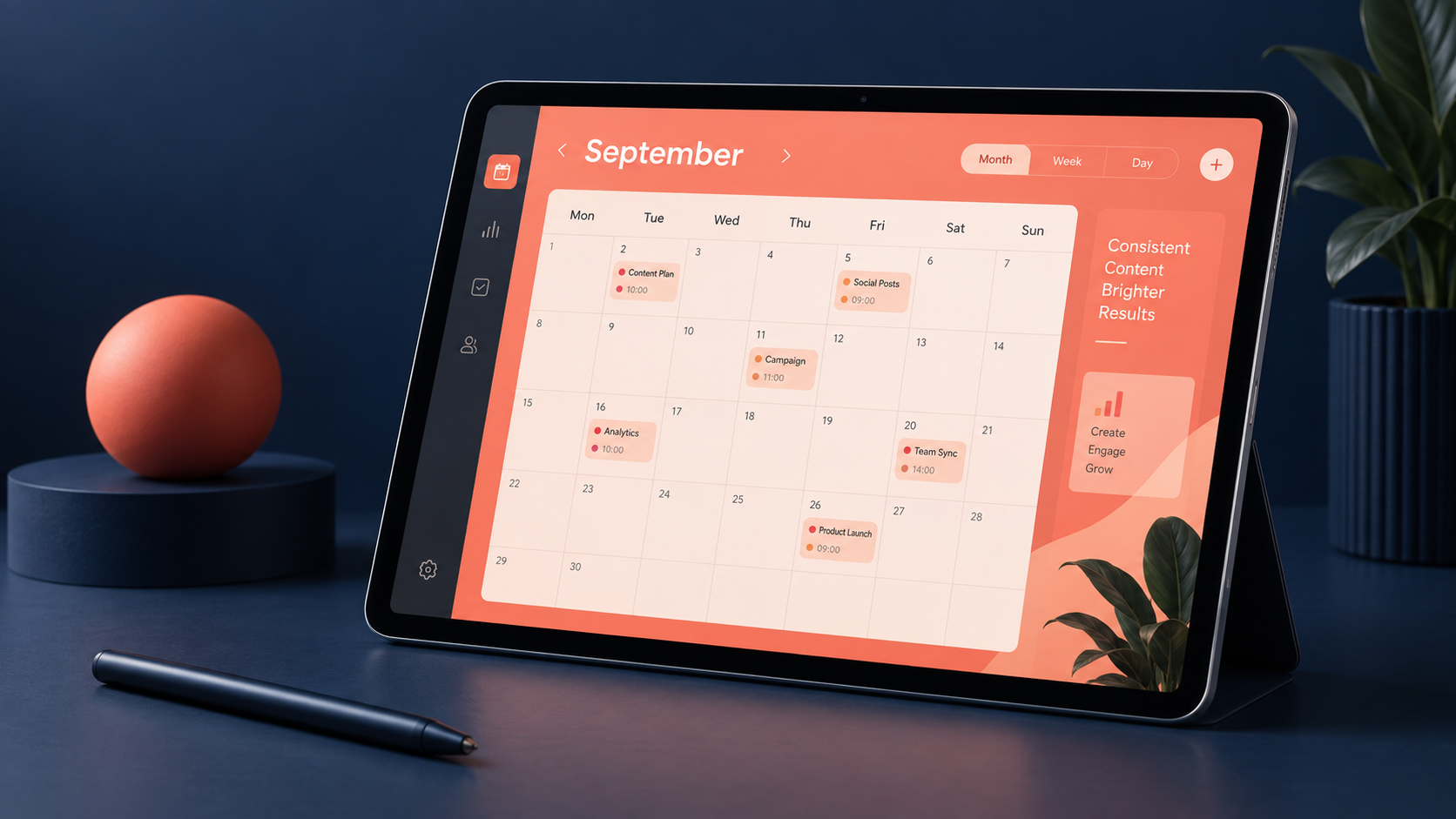
Create calendar views for different needs. A monthly view helps stakeholders understand campaign balance and timing. A weekly production view gives creators and designers a focused list of immediate tasks. A platform view reveals frequency and content gaps, while a campaign view keeps related posts, landing pages, emails, and promotions aligned.
Use labels or filters for content pillars, formats, funnel stages, regions, products, and audiences. This makes the calendar easier to audit. In a few clicks, a marketer should be able to see whether the plan contains too much promotional content, neglects an important audience, or relies excessively on one format.
Develop Content Pillars and a Balanced Publishing Mix
Content pillars are recurring themes that reflect both customer interests and the company’s expertise. They prevent random posting while leaving enough creative freedom for varied execution. Most businesses can work effectively with three to six pillars. Possible pillars include education, industry insight, product use cases, customer success, company culture, community stories, and expert opinion.
Define each pillar clearly. Instead of using a vague category such as “tips,” specify the audience problem and the brand’s perspective. A financial software company might use “cash-flow guidance for growing service businesses,” while a fitness brand could use “short strength routines for people working from home.” Specific pillars generate stronger ideas and make the brand more recognizable.
Balance the calendar across audience value and commercial purpose. Educational posts can answer common questions, explain complex subjects, or provide templates. Trust-building posts might feature customer experiences, behind-the-scenes processes, employee expertise, or transparent lessons. Community posts can invite opinions and participation. Promotional posts should communicate a relevant benefit, offer, or next step rather than simply announcing that a product exists.
There is no universal ratio for educational, community, and promotional content. A new company may need more awareness-building material, while an established retailer may schedule more product-led posts around seasonal demand. Start with a reasonable mix, measure the response, and adjust it according to business outcomes.
Format variety matters too. A strong business social media calendar might combine short videos, carousels, static graphics, photographs, text posts, live sessions, stories, polls, and user-generated content. However, variety should serve the message. Do not turn a simple announcement into a complex video merely to satisfy a format quota.
Build recurring series to reduce planning pressure. Examples include a weekly customer question, a monthly expert interview, a recurring product demonstration, or a Friday roundup. Repeatable formats make production more efficient and give audiences familiar content to anticipate. Refresh the angle and examples so the series remains useful rather than mechanical.
Plan an Efficient Workflow from Idea to Publication
Effective social media planning for business depends on a repeatable production workflow. Begin with a monthly or quarterly planning session that reviews business priorities, product launches, seasonal moments, events, customer questions, and recent performance. Use these inputs to create campaign themes and fill the calendar at a strategic level.
Then hold shorter weekly sessions to confirm priorities, resolve blockers, and accommodate timely opportunities. Keep these meetings operational. The calendar should already show owners, deadlines, and statuses, allowing the team to focus on decisions rather than reciting updates.
Batch similar work whenever possible. A creator can film several short videos in one session, a designer can develop a set of related graphics, and a copywriter can draft a week of posts while the campaign context is fresh. Batching reduces setup time and makes brand consistency easier to maintain.
Create reusable briefs for recurring formats. A good brief identifies the objective, audience, key message, desired action, required assets, platform specifications, references, and deadline. Templates accelerate production without removing creative judgment. They are particularly valuable when freelancers, agencies, or multiple departments contribute.
Establish a clear approval process. Decide which posts require legal, executive, product, or brand review and which can be approved by the social media lead. Routine content should not pass through unnecessary layers. High-risk topics—such as claims, partnerships, competitions, financial information, or crisis communication—deserve stricter controls.
Schedule approved content in advance, but conduct a final contextual check before publication. News events, platform conversations, stock availability, or business changes may make a previously appropriate post insensitive or inaccurate. Automation improves reliability, but human oversight protects judgment and relevance.


Choose Posting Frequency and Timing with Evidence
A sustainable schedule is more valuable than an ambitious schedule that collapses after two weeks. Start by assessing available capacity for strategy, writing, design, video production, community management, and reporting. Publishing creates follow-up work: comments need responses, questions need answers, and strong posts may require rapid amplification.
Set a minimum viable cadence for each channel. This is the frequency the team can maintain without sacrificing quality. Then test increases gradually. A business might begin with three weekly LinkedIn posts, two Instagram feed posts, several stories, and one short-form video. Another company may gain more from one authoritative weekly post than from daily updates.
Use platform analytics to identify when the audience is active, but treat suggested times as starting points rather than fixed rules. Test comparable posts across different days and time windows. Evaluate results over several weeks because one unusually successful or weak post can distort the conclusion.
Account for audience behavior and geography. A business serving local consumers may prioritize evenings and weekends, while a B2B company may see stronger activity during weekday working hours. International brands should consider time zones and may need regional schedules rather than one global publication time.
Frequency should also vary by campaign. A product launch may justify a temporary increase, provided the posts offer distinct value: a problem overview, demonstration, customer example, objection-handling post, and launch offer. Repeating the same sales message several times is more likely to cause fatigue than momentum.
Create Platform-Specific Content Without Duplicating Work
Efficient content planning does not mean copying identical posts across every platform. Each network has different audience expectations, creative conventions, technical constraints, and discovery mechanisms. The central idea can remain consistent, but its presentation should feel native to the channel.
Start with a core content asset or message. A research report might become a LinkedIn analysis, an Instagram carousel, a short video highlighting one surprising statistic, and a series of story questions. A customer webinar could produce clips, quotations, an FAQ post, and a behind-the-scenes photograph. This approach extends the value of strong ideas without forcing teams to invent every post from scratch.
Add platform-specific fields to the calendar for copy, dimensions, hashtags, links, tags, thumbnail text, subtitles, and first comments. This prevents accidental duplication and makes quality control easier. It also ensures that repurposing is intentional rather than a last-minute copy-and-paste exercise.
Protect the core message during adaptation. If each version emphasizes a different claim, audiences may receive an inconsistent impression of the campaign. Define one primary message and one desired action, then adjust the hook, format, length, and tone for each platform.
Plan accessibility as part of production. Include captions for video, meaningful alternative text for images, readable color contrast, and clear on-screen typography. Accessibility should appear in the workflow checklist instead of being added hurriedly before publishing.
Measure Performance and Improve the Calendar
A content calendar should evolve through regular review. At least once a month, compare results against the objectives established during planning. Examine performance by platform, campaign, audience, pillar, format, and call to action. Individual post rankings can be helpful, but patterns across multiple posts produce more reliable decisions.
Look beyond surface-level engagement. A post may receive modest public interaction while generating valuable website visits, direct inquiries, or sales conversations. Conversely, a highly entertaining post may attract attention from people outside the target market. Evaluate whether the content reached the right audience and contributed to the intended outcome.
Add a performance field or reporting link to published calendar entries. Record essential metrics and a short qualitative observation, such as “strong saves from how-to carousel” or “high reach, but low landing-page conversion.” These notes make the calendar a searchable learning archive.
Use a simple testing framework. Change one meaningful variable at a time—such as the hook, format, publication time, creative style, or call to action—while keeping other elements reasonably consistent. Document the hypothesis before publishing and review the result afterward. This creates actionable evidence instead of vague impressions.
Schedule quarterly audits to identify content that can be refreshed, repurposed, retired, or expanded. Evergreen posts with sustained engagement may become guides, videos, lead magnets, or recurring series. Underperforming topics should not always be abandoned; sometimes the subject is valuable but the hook, format, distribution, or targeting needs improvement.
Common Calendar Mistakes to Avoid
One common mistake is planning too far ahead at a level of detail that prevents adaptation. Quarterly planning is useful for campaigns and themes, but final copy for ordinary posts may be better completed closer to publication. Use a layered approach: define strategic priorities early, develop monthly topics, and finalize weekly execution.
Another mistake is treating the calendar as a list of publication dates rather than a production system. If it does not include ownership, dependencies, review deadlines, and asset links, it cannot reliably prevent bottlenecks.
Businesses also overfill calendars in pursuit of consistency. More content is not automatically better. Every post competes for creative resources and audience attention. Remove low-value items and invest more effort in ideas with a clear purpose.
Ignoring community management is equally damaging. The job does not end when a post goes live. Reserve time for monitoring comments, answering messages, escalating service issues, and joining relevant conversations. The business content calendar can include engagement blocks and post-publication responsibilities alongside scheduled posts.
Finally, avoid allowing the calendar to become rigid. Leave open space for customer stories, timely commentary, platform trends, and unexpected business developments. A useful plan provides direction while preserving the ability to respond intelligently.
Frequently Asked Questions
What should a business social media calendar include?
It should include publication dates, platforms, content topics, formats, audience segments, objectives, draft copy, asset links, calls to action, owners, approval statuses, and production deadlines. Businesses should also include campaign labels, tracking links, accessibility requirements, and performance notes when relevant.
How far in advance should businesses plan social media content?
Plan major campaigns and themes one quarter in advance, outline specific topics four to six weeks ahead, and finalize routine posts one or two weeks before publication. Keep part of the schedule flexible so the business can respond to news, trends, customer feedback, and changing priorities.
How often should a business post on social media?
There is no single ideal frequency. Choose a cadence the team can sustain while maintaining quality and responding to the audience. Start with a manageable schedule, measure results by platform, and increase or decrease frequency based on capacity, audience behavior, and business outcomes.
Which tool is best for creating a business content calendar?
The best tool is one that the entire team can access and update consistently. Spreadsheets work well for simple workflows, while project-management and social scheduling platforms are useful for complex approvals, asset management, automated publishing, and reporting. The calendar’s structure and maintenance habits matter more than the specific software.
Turn Your Calendar into a Practical Growth System
A successful business social media calendar combines strategy, production planning, publishing discipline, and continuous learning. Begin with measurable goals and defined audiences, organize content around focused pillars, assign clear ownership, and build enough lead time for thoughtful creation and review.
Keep the system proportional to the business. A smaller team does not need a complicated workflow with dozens of fields, while a multi-market organization should not rely on an informal list of dates. The right calendar removes uncertainty, makes collaboration visible, and helps people spend more time improving content instead of chasing information.
Most importantly, review the plan against real results. Social media planning for business becomes valuable when performance insights shape the next cycle of decisions. With a calendar that is structured but adaptable, businesses can publish more consistently, respond more quickly, and build an online presence that supports meaningful engagement and long-term growth.