
Strategic Social Media Posting Schedule and Tips for Marketers
Effective social media posting schedules boost engagement and reach. Use strategic timing and tips to maximize your marketing impact across platforms.


A strategic social media posting schedule defines what your brand will publish, where it will appear, when it will go live and why it matters to the audience. The most effective schedule is not simply a calendar filled with posts. It connects business goals, audience behavior, platform priorities, production capacity and performance data. By planning content in advance while preserving room for timely updates, marketers can publish more consistently, improve reach and engagement, and spend less time reacting to daily deadlines.
Why a Strategic Posting Schedule Matters | Start with Goals, Audiences and Content Priorities | Build a Sustainable Weekly and Monthly Content Calendar | Choose Posting Times Using Audience Evidence | Create a Workflow for Production, Approval and Scheduling | Balance Planned Content with Trends and Real-Time Engagement | Measure Performance and Improve the Schedule | Common Scheduling Mistakes to Avoid | A Practical Posting Schedule Template | Frequently Asked Questions
Why a Strategic Posting Schedule Matters
Consistency helps audiences recognize and trust a brand. When useful content appears regularly, followers know what to expect and have more opportunities to engage. Consistent publishing also gives social platforms a clearer stream of content to distribute and gives marketers enough data to identify patterns. However, consistency should never mean posting for the sake of filling a slot. Three relevant, well-produced posts can create more value than seven rushed updates.
A structured schedule also turns social media into a manageable marketing system. Without one, teams often repeat topics, overlook campaigns, miss approval deadlines or publish several promotional messages in a row. A schedule makes the content mix visible. Marketers can see whether they are balancing education, entertainment, community interaction, brand storytelling, product promotion and customer proof.
For a business, scheduling is especially important because social content must support broader priorities. A social media posting schedule for business should coordinate product launches, seasonal campaigns, events, sales periods, recruitment activity and customer communications. It should also clarify ownership: who develops the idea, who creates the asset, who checks the copy and who approves publication.
The schedule creates efficiency without eliminating creativity. Once recurring work is organized, creators have more time to develop stronger hooks, improve visuals and respond thoughtfully to trends. The calendar should function as a framework rather than a cage. Planned posts provide stability, while flexible spaces allow a brand to participate in relevant conversations.
Start with Goals, Audiences and Content Priorities
Before choosing posting times, define what social media needs to accomplish. A brand focused on awareness may prioritize reach, video views and profile visits. A demand-generation team may track qualified traffic, leads and assisted conversions. A creator building a community may care most about meaningful comments, shares, saves and returning viewers. Clear objectives determine the formats, calls to action and publishing frequency that belong in the schedule.
Next, map the audience by platform. The same customer may use LinkedIn to learn about industry developments, Instagram to discover ideas and TikTok to watch practical demonstrations. Do not automatically publish identical material everywhere. Adapt the angle, opening hook, format and level of detail to the behavior people bring to each channel.
Create three to five content pillars that connect audience needs with brand expertise. A software company, for example, might use productivity education, customer workflows, product demonstrations, industry commentary and company culture. A fitness creator might focus on technique, simple routines, recovery, nutrition habits and personal stories. Every proposed post should fit a pillar or support a specific campaign goal.
Then assign a purpose to each pillar. Educational content may generate saves and search visibility. Customer stories can build trust. Behind-the-scenes material can humanize the brand. Promotional posts may drive trials or purchases. This prevents a common mistake: producing varied-looking content that always delivers the same message.
A practical social media planning schedule should also reflect the customer journey. Include content for people discovering the brand, evaluating its credibility and considering an action. If every post assumes the audience is ready to buy, engagement will decline. Use an intentional sequence: identify a problem, teach a useful method, show evidence and then present the offer.

Build a Sustainable Weekly and Monthly Content Calendar
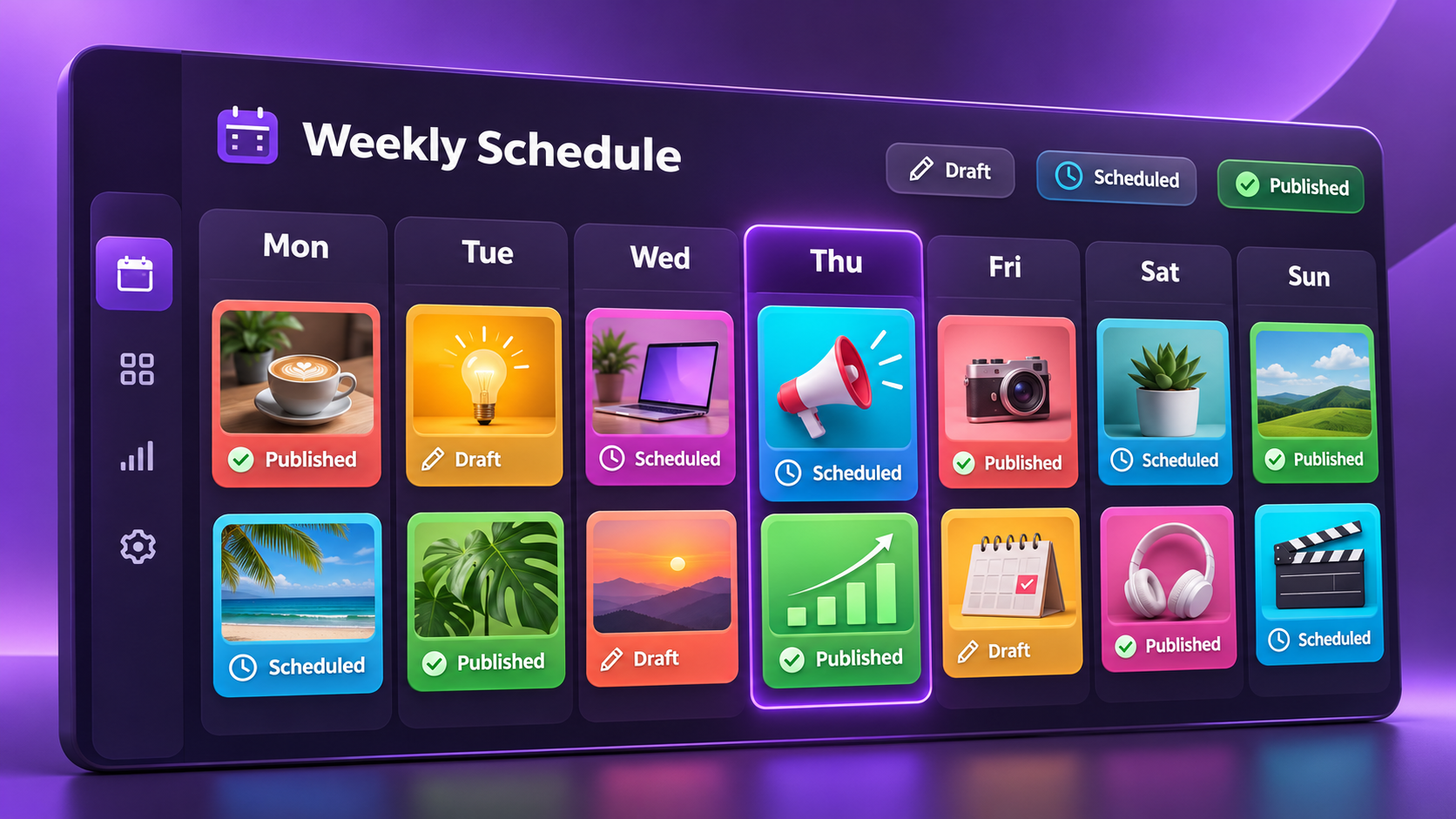
The best way to plan social media posts is to work from broad priorities toward individual publishing slots. Begin with a monthly view containing campaigns, launches, holidays, events and major editorial themes. Then use a weekly view to assign formats, channels, deadlines and owners. Finally, prepare each post with its caption, creative asset, destination link, tags and approval status.
A useful calendar should contain more than dates. Add fields for platform, content pillar, audience segment, objective, format, working title, call to action, asset location, owner and status. Campaign tracking labels and UTM parameters are helpful when social posts drive website traffic. These details make the calendar an operational tool rather than a list of vague ideas.
Set a publishing frequency your team can maintain without sacrificing quality. A small team may start with three strong weekly posts on its primary platform and one or two adapted posts elsewhere. A larger brand may publish daily, supported by specialists for video, design, copy and community management. Capacity should determine the baseline. Increase frequency only when the team can sustain production and the additional posts produce measurable value.
Use recurring content series to reduce planning effort. A weekly tutorial, monthly customer spotlight, Friday trend analysis or regular question-and-answer post gives the audience a recognizable format and gives creators a dependable starting point. Recurring series should still evolve based on performance; familiarity is useful, but repetition without fresh value becomes predictable.
Batching makes it easier to pre plan social media posts. Instead of switching between ideation, writing, filming and design every day, group similar tasks. Develop several ideas in one session, write a week of captions together and film multiple short videos during one setup. Batching reduces context switching and makes visual consistency easier to maintain.
Leave approximately 15 to 25 percent of the calendar open when timely participation matters to the brand. These flexible slots can accommodate company news, audience questions, trend responses or fast-moving industry developments. Evergreen content can be moved to another day if a more relevant opportunity appears.
Choose Posting Times Using Audience Evidence
Universal “best time to post” studies can provide a starting point, but they cannot replace first-party data. An effective schedule for posting on social media should reflect when a specific audience is active and when it is receptive to a particular message. A professional audience may engage with industry analysis during weekday mornings, while entertainment content may perform better during evenings or weekends.
Start with native platform analytics. Review follower activity by day and hour, then compare it with post-level results. Look beyond total likes. Examine reach, watch time, completion rate, saves, shares, link clicks and substantive comments. A time slot that produces fewer impressions but more qualified clicks may be more valuable than one that generates passive views.
Consider content context as well as audience availability. A quick motivational video may suit the start of the day. A detailed carousel may perform better when users have time to read. Event reminders should appear early enough for people to act, while live coverage needs to be published immediately. Timing is a relationship between the audience, the format and the desired behavior.
If the audience spans multiple time zones, identify the regions that contribute most to current goals. Publish separate versions for major markets when the potential return justifies it. Otherwise, select a time that overlaps active periods and use reposting or alternate formats to reach people who were offline during the first release.
Test timing systematically. Choose two or three realistic time windows and use comparable posts over several weeks. Avoid drawing conclusions from one viral success or one weak result. Content quality, topic relevance, distribution and competition can all affect performance. A four-to-eight-week sample usually provides a more dependable signal than a handful of posts.
Timing also includes community response. Scheduling a post when nobody can monitor comments may waste its strongest engagement window. For important launches or conversation-led posts, publish when a team member can reply, answer questions and encourage discussion during the first hour.
Create a Workflow for Production, Approval and Scheduling
A reliable publishing rhythm depends on deadlines before the public posting date. Work backward from publication. A short text post may require only drafting and review, while a campaign video may need scripting, filming, editing, captions, legal checks and stakeholder approval. Assigning internal due dates exposes bottlenecks before they cause missed posts.
Use clear workflow stages such as idea, approved, in production, ready for review, scheduled, published and analyzed. Every post should have one accountable owner, even when several people contribute. Shared ownership without a final decision-maker often leads to delayed approvals or last-minute revisions.
Create concise approval standards. Reviewers should know whether they are checking strategic alignment, factual accuracy, brand voice, visual quality, legal risk or all five. Define which everyday posts can be approved by the social media manager and which require input from product, legal or leadership teams. Not every post needs the same level of governance.
Scheduling tools can centralize assets and reduce manual publishing work. Before scheduling, preview line breaks, image crops, thumbnails, tags and links for each platform. Features do not always transfer cleanly between networks, so verify platform-specific elements such as collaborators, music, polls, product tags or first comments.
Schedule evergreen and campaign content in advance, but review the queue regularly. A post that was appropriate on Monday may become insensitive or confusing after unexpected news. Establish a pause procedure so the team can quickly stop scheduled content during a crisis, major event or change in business conditions.
Balance Planned Content with Trends and Real-Time Engagement
Strategic planning should make a brand more responsive, not less. When core content is already prepared, marketers have more capacity to evaluate trends and join relevant conversations. The key is selectivity. A trend deserves attention only when it connects naturally with the audience, brand voice or product.
Use a simple relevance test before participating. Ask whether the audience cares about the topic, whether the brand has something distinctive to contribute and whether the opportunity can be executed while it is still timely. If the answer to any question is no, keep the planned schedule. Forced trend participation can make a brand appear opportunistic or out of touch.
Real-time engagement also includes responding to the brand’s own community. Reserve daily time for comments, mentions, direct messages and relevant conversations on other accounts. These activities should appear in the social media planning schedule even though they are not conventional posts. Community interaction strengthens relationships and can generate ideas for future content.
Build an idea-capture process for recurring questions. If several customers ask the same thing, turn the answer into a post, video or carousel. Comments can reveal objections, unclear product features and language the audience naturally uses. This makes community management a source of editorial research rather than a separate support task.
Measure Performance and Improve the Schedule
A posting schedule becomes strategic when results change what happens next. Conduct a brief weekly review for immediate adjustments and a deeper monthly review for patterns. Compare performance by content pillar, format, platform, day, time and objective. The goal is not merely to identify the top post, but to understand why it worked.
Use metrics that match the post’s purpose. Reach and video views can indicate awareness. Saves and shares can show practical or social value. Comments may signal conversation, although quality matters more than volume. Click-through rate, conversions and qualified leads are appropriate for action-focused content. No single metric can evaluate every post.
Calculate efficiency as well as output. Track the time or cost required to produce different formats. A polished video may deliver high reach but consume several days of work, while a simple expert-led post may generate stronger leads in an hour. These comparisons help marketers allocate resources rather than automatically copying the format with the largest visible numbers.
Keep winning concepts in rotation, but refresh their execution. A strong tutorial can become a carousel, short video, checklist, live discussion or updated seasonal version. Repurposing extends the value of research and production without publishing identical content repeatedly.
When performance declines, change one meaningful variable at a time. Test the hook, topic, format, publishing window or call to action. If everything changes at once, the result provides little guidance. Record tests in the calendar so future decisions rely on accumulated evidence rather than memory.
Every month, decide what to continue, improve, stop and explore. Continue reliable formats, improve promising ideas, stop low-value activity and reserve capacity for experiments. This simple review keeps the schedule aligned with audience behavior and business priorities.

Common Scheduling Mistakes to Avoid
One common mistake is treating every platform as a distribution outlet for the same asset. Cross-posting can save time, but direct duplication often ignores format conventions and audience expectations. Adapt the creative dimensions, caption structure, hook and call to action. A concept can remain consistent while its execution changes.
Another mistake is overfilling the calendar. A packed schedule creates the appearance of productivity, yet leaves no capacity for quality control, community interaction or emerging opportunities. If the team repeatedly misses deadlines, reduce frequency and strengthen the production system before adding more posts.
Marketers also make weak decisions when they optimize only for posting time. A perfect time cannot rescue an irrelevant topic or unclear opening. Content-market fit, creative quality and distribution usually matter more than small differences between adjacent time slots.
Avoid relying entirely on automation. Scheduling reduces repetitive work, but social media is still social. Monitor published posts, respond to people and verify that scheduled content appears correctly. Automated publishing should support human participation, not replace it.
Finally, do not let the calendar become disconnected from business activity. Meet regularly with sales, customer support, product and leadership teams. Their insights can reveal upcoming announcements, customer pain points and useful proof. A connected schedule produces content that is more accurate, timely and commercially relevant.
A Practical Posting Schedule Template
A simple weekly framework can help a team begin without creating an overly complex system. Monday might feature an educational insight tied to a core content pillar. Tuesday can focus on community engagement and comment research. Wednesday may include a product demonstration or practical workflow. Thursday can present customer proof, a case study or an expert opinion. Friday may use a lighter behind-the-scenes post, a weekly summary or an audience question.
This template should be adapted rather than copied blindly. A business-to-business brand may concentrate activity on weekdays, while a hospitality, entertainment or consumer brand may need strong evening and weekend coverage. The right cadence depends on customer habits, available resources and the role each platform plays.
For every scheduled item, document the objective, audience, format, hook, key message, call to action, owner, deadline and success metric. Add a post-publication field for results and lessons. Over time, the calendar becomes a searchable record of what the brand has tested and learned.
Begin with a four-week pilot. Schedule dependable content, reserve several flexible slots and choose one timing or format experiment. At the end of the month, review the evidence and adjust the next cycle. This approach is more sustainable than trying to design a perfect annual calendar before the team understands what works.
Frequently Asked Questions
How far in advance should social media posts be planned?
Most teams benefit from planning themes and campaigns four to eight weeks ahead while finalizing individual posts one to two weeks before publication. Major launches may require several months of preparation. Keep some capacity open for current events, community questions and relevant trends.
How often should a business post on social media?
There is no universal frequency. Start with a cadence the team can maintain at a high standard, such as three to five weekly posts on a primary channel. Evaluate reach, engagement, conversions and production capacity before increasing volume. Consistent value matters more than daily posting.
Should the same post be published on every platform?
The same central idea can be used across platforms, but its execution should be adapted. Adjust the opening, length, dimensions, format and call to action for each channel. This preserves production efficiency while respecting how audiences consume content in different environments.
What is the best way to plan social media posts when resources are limited?
Prioritize one or two platforms, define a small set of content pillars and use recurring series. Batch similar production tasks, repurpose strong ideas and schedule evergreen posts in advance. Measure results monthly, then direct limited resources toward the formats and channels that support meaningful business goals.