
Soci Social Media Scheduler: Features and Pricing Overview
Soci Social Media Scheduler offers powerful tools and flexible pricing to streamline your social media management and boost online engagement effectively.


The SOCi social media scheduler is an enterprise platform for planning, approving, publishing, and measuring localized social content across large networks of business locations. Unlike lightweight scheduling tools built for individual creators or small teams, SOCi combines social publishing with brand governance, location-level customization, engagement management, analytics, local search, reputation management, and AI-powered automation. SOCi scheduler pricing is not publicly listed: prospective customers must request a customized quote based on their locations, products, integrations, and service requirements.
What Is the SOCi Social Media Scheduler? | Core Scheduling and Publishing Features | Multi-Location Management, Engagement, and Analytics | SOCi Scheduler Pricing and Contract Structure | SOCi Compared with Other Social Media Schedulers | Advantages and Limitations to Consider | How to Evaluate SOCi Before Buying | Who Should Choose the SOCi Scheduler? | Frequently Asked Questions
What Is the SOCi Social Media Scheduler?
SOCi is a local marketing platform designed primarily for franchises, retail chains, property management companies, dealerships, healthcare networks, and other organizations operating many physical locations. Its social media functionality gives a central marketing team one place to manage corporate and local accounts without forcing every location to work independently.
The scheduler addresses a difficult operational problem. A multi-location brand may need to distribute a national campaign across hundreds of Facebook, Instagram, LinkedIn, or other social pages while adjusting the copy, offers, links, and creative assets for individual markets. Publishing manually is slow, but posting identical content everywhere can make local pages feel impersonal. SOCi is designed to balance scale with local relevance.
Corporate marketers can develop approved campaigns, organize reusable assets, schedule content across groups of locations, and define what local users may edit. Location managers can then participate within the permissions assigned to them. Depending on the organization’s configuration, they may publish local content, personalize approved posts, submit material for review, or manage customer interactions.
This means SOCi social media management is broader than a conventional content calendar. Scheduling is one component of a centralized system that also supports governance, customer engagement, performance analysis, listings, reviews, and local visibility. That scope is valuable for complex organizations, although it can be unnecessary for a creator who only needs to queue posts for a handful of profiles.

Core Scheduling and Publishing Features
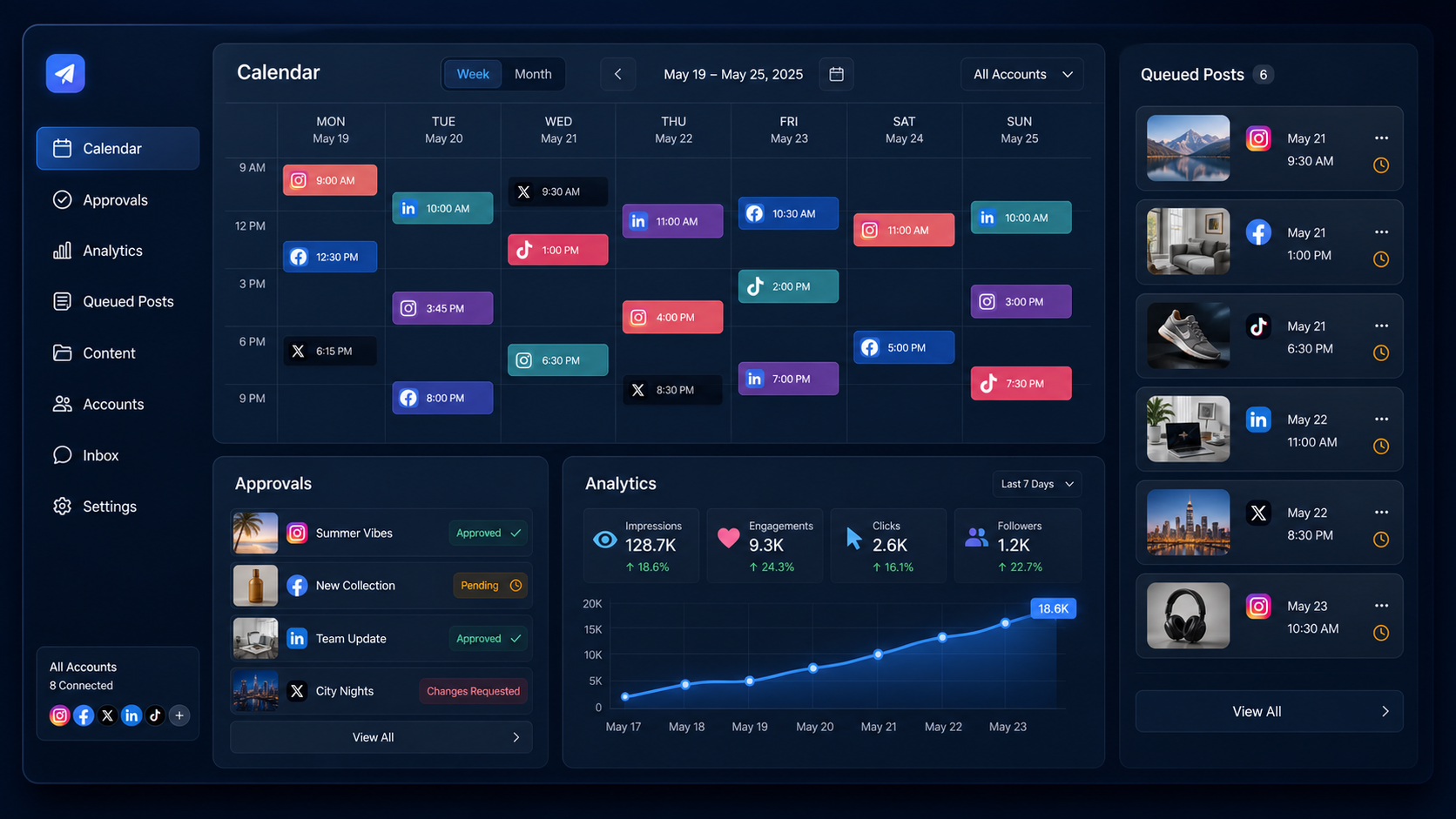
The heart of the platform is a centralized publishing workflow. Marketers can prepare posts in advance, assign dates and times, review scheduled activity in a calendar, and distribute campaigns to selected locations. Group-based publishing helps teams target content by region, market, franchise ownership, store type, or another business structure rather than selecting every profile manually.
Content libraries provide a controlled source of approved copy and creative assets. A corporate team can prepare evergreen posts, seasonal promotions, product announcements, community campaigns, and event templates for local users. This reduces duplicated work and helps prevent employees from using outdated logos, expired offers, or unapproved messaging.
Localization is one of the scheduler’s most important capabilities. Instead of treating each social profile as an unrelated channel, SOCi can support workflows in which a campaign is adapted across multiple locations. Variables and structured location data may be used to incorporate relevant details such as a location name, offer, address, or market-specific message. Teams should still preview posts carefully because character limits, image specifications, tagging options, and publishing behavior differ by network.
Approval controls help organizations maintain quality without routing every request through email or spreadsheets. Administrators can establish roles, permissions, and review steps so local users have an appropriate level of freedom. SOCi has also introduced configurable posting buffers, allowing organizations to reserve review time before scheduled content goes live. For regulated or tightly controlled brands, this creates a useful operational safeguard.
Recent SOCi capabilities extend beyond manual scheduling. The Genius Social Agent is positioned as a brand-trained AI agent that can plan, create, approve, and publish localized social content according to an organization’s guidelines and risk tolerance. AskGenius provides a conversational interface for tasks such as scheduling a post, rewriting copy, or creating a post from an uploaded image. Human oversight remains important, particularly for promotions, claims, legal disclaimers, and sensitive local events.
Multi-Location Management, Engagement, and Analytics
SOCi’s distinguishing advantage is its ability to coordinate activity across a large location hierarchy. A central team can control the brand framework while regional managers, franchisees, or local employees work with the pages assigned to them. Permissions can help separate responsibilities and reduce the risk of one user accidentally changing or publishing content for an unrelated location.
Local participation can make a measurable difference. Corporate posts supply consistency, but local teams know about neighborhood events, employee stories, regional promotions, inventory, and community partnerships. A practical SOCi workflow combines both: headquarters supplies a reliable campaign baseline, and local operators add timely material that makes each page useful to nearby customers.
Engagement management brings customer activity into the same operational environment. Depending on the purchased products and connected networks, teams can monitor and respond to comments or messages, route tasks, and manage interactions across locations. Centralizing this work makes it easier to establish response standards and prevent important customer questions from being overlooked.
Reporting can be viewed at different organizational levels, enabling marketers to compare locations, campaigns, and content. Campaign tags and consistent naming conventions are essential. Without them, a large dataset can still produce weak answers. Before launch, define a taxonomy for business objectives, regions, content themes, campaigns, and formats so reports can reveal which activities actually drive reach, engagement, clicks, or conversions.
Teams should avoid evaluating every location against a single raw engagement total. Audience size, local demand, publishing frequency, and market maturity can distort comparisons. Useful performance frameworks combine absolute results with normalized metrics such as engagement rate, response rate, posting consistency, and improvement over a location’s own baseline.

SOCi Scheduler Pricing and Contract Structure
SOCi does not publish a standard self-service price list for its social media product. There is no universally advertised monthly plan comparable to the entry-level packages offered by many small-business schedulers. Organizations are directed to request a demonstration and speak with the sales team for a tailored proposal.
As a result, any third-party page claiming a fixed SOCi scheduler pricing figure should be treated cautiously unless the quote is recent, clearly scoped, and directly attributable to SOCi. Enterprise software costs can change substantially according to the contract. A price negotiated for a regional organization using one product should not be assumed to apply to a national franchise purchasing several modules.
A SOCi quote may be influenced by factors such as:
- The number of business locations and social profiles being managed.
- The SOCi products included, such as Social, Reviews, Listings, Pages, Ads, Surveys, Chat, Shield, or AI agents.
- The number and types of corporate, regional, and local users.
- Required approval workflows, compliance controls, integrations, and reporting capabilities.
- Onboarding, implementation, training, managed services, and customer support requirements.
- Contract duration and the complexity of the organization’s location hierarchy.
For a useful quote, give the vendor a precise inventory rather than simply asking for “social media management.” Document the number of locations, active profiles by network, user roles, expected monthly publishing volume, approval requirements, existing technology, security review process, and desired integrations. Ask the sales representative to separate recurring software fees from one-time implementation and optional service costs.
The contract review should also cover renewal increases, minimum commitments, additional-location fees, support levels, data retention, API access, content export, termination assistance, and the cost of adding modules later. Calculate the three-year total cost of ownership instead of comparing only the first-year subscription. Implementation labor and internal administration can materially affect the real cost.

SOCi Compared with Other Social Media Schedulers
SOCi competes with several categories of software, so the most relevant alternative depends on the job being done. Buffer, Later, Metricool, and similar tools generally appeal to creators, freelancers, and smaller marketing teams that prioritize straightforward scheduling and accessible pricing. Hootsuite, Sprout Social, and Agorapulse offer broader publishing, listening, engagement, reporting, and collaboration capabilities. Other local marketing platforms compete more directly with SOCi by combining social activity with listings, reviews, and location management.
The biggest difference is organizational architecture. Most schedulers begin with social accounts and users. SOCi begins with the needs of a multi-location business: corporate oversight, groups of locations, local permissions, scalable localization, and coordination across local search, reputation, and social channels. That difference can justify a more involved implementation for a brand managing hundreds of pages.
| Evaluation area | SOCi | Typical self-service scheduler |
|---|---|---|
| Best-fit customer | Franchises and multi-location enterprises | Creators, agencies, and small or midsize teams |
| Pricing model | Customized sales quote | Published monthly or annual plans |
| Primary strength | Localized execution with centralized governance | Fast setup and convenient content scheduling |
| Location hierarchy | Core part of the operating model | Often represented through workspaces or account groups |
| Broader local marketing | Can include listings, reviews, pages, ads, and other products | Usually limited to social publishing, engagement, and analytics |
| Implementation | Typically sales-assisted and organization-specific | Usually self-service |
For a five-person team managing six brand accounts, an enterprise implementation may add cost and complexity without enough benefit. For a franchise with 500 locations, however, a low-cost scheduler may become difficult to govern even if its subscription appears cheaper. The correct comparison is not price per user alone. It is the cost of producing, approving, localizing, publishing, monitoring, and reporting on content across the entire network.
During a competitive review, create a realistic test campaign. Ask each vendor to demonstrate how the same campaign would be distributed to 50 locations, localized for five markets, reviewed by regional approvers, protected from unauthorized edits, and reported at corporate and location levels. This exposes workflow limitations that feature checklists often hide.
Advantages and Limitations to Consider
The main advantage of SOCi social media management is operational control at scale. Central teams gain a common system for campaigns, assets, permissions, approvals, and reporting, while local operators can contribute within defined boundaries. The combination can reduce repetitive publishing work and create a more consistent customer experience across locations.
The platform is also attractive when social media is only one part of a wider local marketing program. Managing social content, local listings, reviews, and other customer touchpoints through one vendor may reduce fragmented workflows and give leadership a more unified view of local performance. AI-assisted creation and execution may further reduce routine work when governance rules are properly configured.
However, pricing opacity makes early budgeting difficult. A buyer cannot immediately compare a public SOCi plan with a competitor’s published subscription. The sales, security, procurement, onboarding, and configuration process may also be more extensive than a small team expects from a conventional scheduler.
SOCi can be excessive for solo creators, small businesses with one location, and agencies that mainly need an affordable calendar, client approvals, and basic reporting. Its value depends on whether location governance and localization are genuine operational problems. Buying an enterprise platform without assigning owners, setting approval policies, and training local users can leave much of that value unrealized.
AI automation introduces another consideration: scale magnifies mistakes. An inaccurate date or unsuitable claim is more damaging when distributed across hundreds of local pages. Establish rules for which content can publish automatically, which categories require approval, who handles exceptions, and how teams pause campaigns during emergencies.
How to Evaluate SOCi Before Buying
Begin with a workflow audit. Map how ideas become approved posts, how assets are stored, who adapts corporate campaigns, who answers customers, and how results reach leadership. Record the time spent on each step and the common sources of delays or errors. This creates a baseline for estimating the platform’s potential return.
Next, prepare a scorecard with weighted requirements. High-priority criteria might include bulk publishing, location grouping, granular permissions, approval deadlines, audit trails, content localization, analytics, integrations, and data security. Give less weight to impressive features that do not solve a documented business problem.
Use the product demonstration to test real scenarios rather than accepting a generic tour. Ask SOCi to show how an administrator creates a national campaign, excludes selected locations, permits limited local edits, routes the result through approval, reschedules content, and compares performance across regions. Include at least one exception, such as a location with a different promotion or an approver who misses a deadline.
Request a pilot when feasible. A representative group should include corporate marketers, regional approvers, technically confident local managers, and less experienced users. Measure adoption, time saved, publishing errors, approval speed, local participation, response performance, and content output. Pilot results are more reliable than assumptions about how users will behave.
Finally, define success before signing. Suitable objectives might include reducing campaign deployment time, increasing the percentage of active local pages, improving response rates, expanding localized publishing, or replacing overlapping software. A platform should be judged against those operational and marketing outcomes, not merely by the number of features enabled.
Who Should Choose the SOCi Scheduler?
SOCi is most compelling for organizations with dozens, hundreds, or thousands of locations that need centralized oversight without eliminating local marketing. It is particularly relevant when multiple business units share brand standards, content resources, compliance obligations, and reporting requirements.
A strong candidate usually has several signs of operational strain: campaign files moving through email, local pages publishing inconsistent creative, headquarters lacking visibility, regional teams repeating the same work, or customer comments receiving uneven responses. If listings and review management are also fragmented, SOCi’s broader platform may provide additional value.
Smaller teams should consider a simpler scheduler when they do not need location hierarchies, enterprise permissions, or a broader local marketing suite. The ability to start quickly, see prices publicly, and pay monthly may matter more than advanced governance. In that case, SOCi should not be rejected for lacking features; it should be rejected because the organization does not yet have the complexity those features are designed to manage.
The practical verdict is straightforward: SOCi is not merely a publishing queue. It is an enterprise system for coordinating localized marketing at scale. Request a tailored demonstration and detailed commercial proposal if that matches your operating model. Otherwise, compare self-service schedulers that offer the essential calendar, collaboration, and reporting functions at a more transparent price.
Frequently Asked Questions
Does SOCi have a social media scheduler?
Yes. The SOCi social media scheduler supports advance planning, approval, publishing, and management of content across groups of local social profiles. Its key differentiator is the ability to coordinate corporate and location-level activity within one governed workflow.
How much does SOCi scheduler pricing cost?
SOCi does not publish standard package prices for the scheduler on its website. Businesses must request a demo and customized quote. The final cost can depend on location count, selected products, users, integrations, onboarding, support, and contract terms.
Is SOCi suitable for creators and small businesses?
It can technically support social publishing, but SOCi is primarily positioned for multi-location brands and enterprises. A creator or single-location business will usually find a self-service scheduler faster to adopt and easier to budget unless it has unusually complex governance or local marketing needs.
What should businesses compare before choosing SOCi?
Compare total contract cost, supported networks, location capacity, user permissions, approval workflows, localization tools, engagement coverage, analytics, integrations, implementation services, support, and data portability. Test each finalist with the same multi-location campaign so the comparison reflects real work rather than marketing claims.